

ORSANCO initiated clean metals monitoring in 1998 to allow metals analysis at very low levels. Samples are collected bimonthly from the 16 Ohio River stations and analyzed for 25 metals, both in dissolved and total forms. These data are used to assess compliance with water quality criteria, and to evaluate the river’s ability to support fish and macroinvertebrates.
Metals
- Aluminum
- Antimony
- Arsenic
- Barium
- Beryllium
- Cadmium
- Calcium
- Chromium
- Copper
- Fixed Suspended Solids
- Hardness (CaCO3)
- Iron
- Lead
- Magnesium
- Manganese
- Mercury
- Nickel
- Potassium
- Selenium
- Silver
- Strontium
- Thallium
- Total Suspended Solids
- Volatile Suspended Solids
- Zinc
Sample Locations
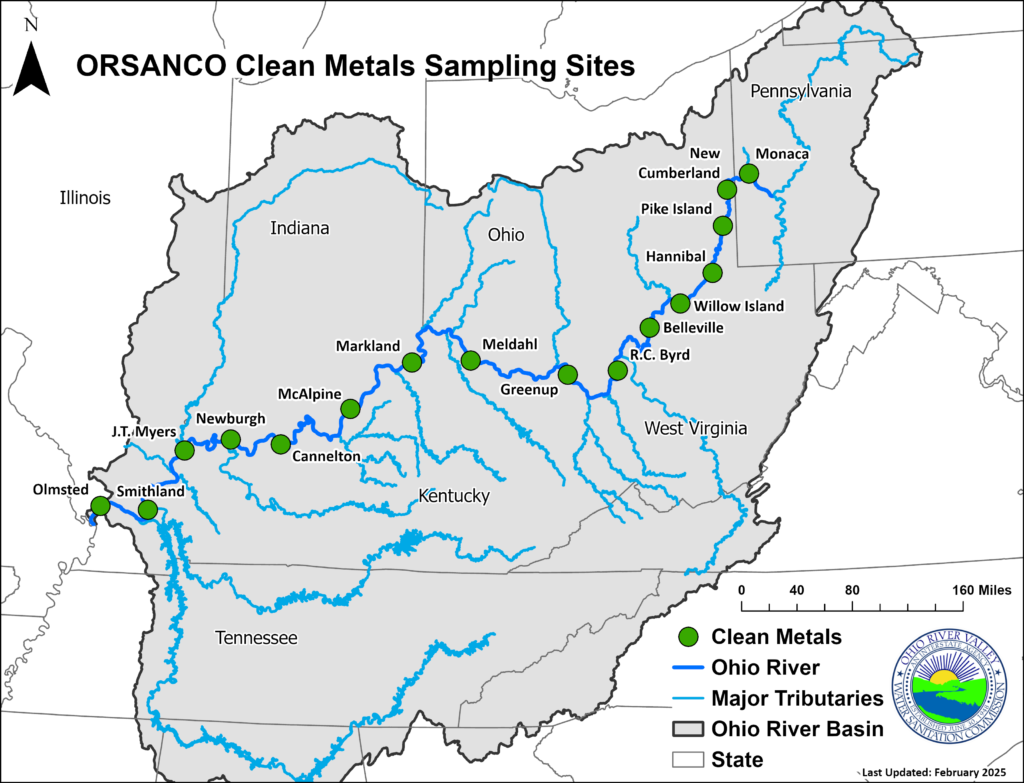
Clean Metals Program Samples are collected at 16 Ohio River Monitoring Stations:
- Monaco, PA, Mile 26.3
- New Cumberland L&D, Mile 54.4
- Pike Island L&D, Mile 84.2
- Hannibal L&D, Mile 126.4
- Willow Island L&D, Mile 161.8
- Belleville L&D, Mile 203.9
- R.C. Byrd L&D, Mile 279.2
- Greenup L&D, Mile 341.0
- Meldahl L&D, Mile 436.2
- Markland L&D, Mile 531.5
- McAlpine L&D, Mile 606.8
- Cannelton L&D, Mile 720.7
- Newburgh L&D, Mile 776.0
- J.T. Myers L&D, Mile 846
- Smithland L&D, Mile 918.5
- Olmsted L&D, Mile 964.8
Historical ORSANCO metals data, collected by standard grab sample techniques for total recoverable metals analysis, indicated violations of Aquatic Life Use Criteria1. In October 2000 the Commission adopted dissolved metals criteria believing that its total recoverable metals data indicating aquatic life impairment was not consistent with the findings of its fish population studies and that the dissolved portion of most metal contaminants was the more toxic and bioavailable component. Clean metals sampling data, collected since 1998 at three stations and at all Ohio River stations by 2003 has indicated few violations of aquatic life use criteria (<10% violations per year at all stations).
To support dissolved metals criteria and the development of numeric translators for dissolved metals a sampling plan was implemented to characterize dissolved metals concentrations in the Ohio River. Using a modification2 to the clean technique devised by the Virginia Department of Environmental Quality for ultra-clean collection to satisfy USEPA 1669 Field Methods3, ORSANCO now samples all 16 of its Ohio River main stem Bimonthly Sampling Program locations for dissolved and total recoverable metals.
Sampling Technique

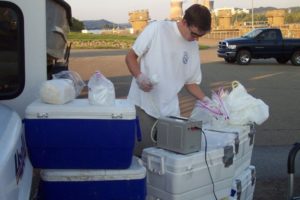
The clean technique for dissolved and total recoverable metals is based around collection of stream water through a peristaltic pump and Teflon tubing approved by USEPA for the collection of metals samples. Raw water samples can be collected directly through the tubing or with the use of a pre-cleaned and self-filling 4L collection bottle
Use of this equipment eliminates a sampler’s direct contact with the containers and stream sample itself and minimizes exposure of the sample and container to ambient air. All equipment used for collection is cleaned, rinsed and double-bagged by the laboratory to prevent contamination during transport and storage. Containers and equipment are manipulated with gloved hands only, for the one-person method used by ORSANCO one gloved hand is “dirty hand” and the other “clean hand” in place of a two-person team segregating tasks to one or the other person.
The dissolved portion of the sample is collected using a disposable 0.45 micron filter. One field blank is collected per day. Prior to filtering the sample each filter is pre-wet and rinsed in the field with one-liter of blank water. The same filter is used to collect a one-liter blank. All rinse and blank water is provided by the laboratory. Using stream water the filter is purged of blank water then one liter of stream water is filtered to represent the dissolved portion. One liter of sample water is also transferred to a sample container using the tubing without the filter; this sample represents the total recoverable portion. The filter is discarded after collection of each stream water sample. Samples are held on ice for delivery to the laboratory.
1. Cd, Cu, Pb, Zn were the cause of “partially supporting” (>10% criteria violations) designations, 305b assessments 1990-1991, 1992-1993, 1994-1995, 1996-1997.
2. Procedure modification allows a two-person technique to be performed by an individual sampler.
3. All metals analyses are done by USEPA Method 1638 with the exception of mercury (245.7) and iron, calcium, and magnesium (200.7).

Clean metals sampling equipment includes: 4L laboratory pre-cleaned sample collection containers, Teflon ® tubing, non-contact peristaltic pumps, pre-cleaned 0.45um filters, and pre-cleaned processed sample containers.
Samples can also be collected using the same equipment by pumping directly from the water source.
For more information on ORSANCO Clean Metals Sampling Program, please contact Riley Lanfear.