The Weekly Ohio River Water Quality Report provides basic water quality and river condition information for six locations along the Ohio River: Pittsburgh, Wheeling, Huntington, Cincinnati, Louisville, and Evansville. The report is updated weekly, and is intended to provide river users with basic information about the Ohio River. Weekly Water Quality Report StoryMap
Water Quality Report for 5.29.26:
- ALL bacteria monitoring sites have exceedances this week*
- Water temperatures have remained steady
- Stages, flows, and velocities have increased from last week. River will crest on 5/31. Cincinnati & Evansville are still in action stage.
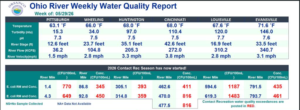
Contact recreation season is underway!
*E. coli ≤ 240 CFU/100 mL with no recent rainfall → more favorable conditions. Full body contact with the river water is not recommended when E.coli concentrations exceed 240 CFU/100mL.
Swimming, Fishing, Paddling the Ohio? Here’s What You Need to Know This Season.
Learn more about our contact recreation bacteria monitoring program here. Learn more about recreation on the Ohio River here.
For more information on ORSANCO’s Weekly Water Quality Report, please contact Lila Xepoleas Ziolkowski.
Water Temperature– River water temperatures are measured sub-surface at intake depths and may not be reflective of the current temperature at the surface.
Turbidity– The measure of light scattering particles in the water that make the water look murky or muddy; the lower the turbidity, the clearer the water. The turbidity of the Ohio River can range from as low as single digits to 1200 NTUs (nephelometric turbidity units) as seen during flood conditions.
Stage– The measurement of the vertical elevation of the surface of the river
Velocity– How fast the water is moving. Velocities on the Ohio River can range from 0.1 mph under low flow to 5 mph at flood stage.
Flow– How much water is moving. The volume of water moving in kilo cubic feet per second. (KCFS) . 1 cubic foot is about the size of a basketball. Based on model-simulated projections at 7 am ET. Forecasts include expected precipitation through the first 48 hours.
Bacteria– Bacteria concentrations in the Ohio River (and tributaries) can change rapidly following rain events. Rain can wash land-based bacteria from the watershed into the river/tributaries. Bacteria can also enter the system following rain events from combined sewer overflows. Full body contact with the river water, i.e., swimming, is not recommended when E.coli concentrations exceed 240 CFU/100mL.
HAB– Harmful Algal Bloom. Cyanobacteria or green algae that may produce toxins and can be detrimental to mammals. Under HAB conditions, direct contact and ingestion are not recommended.