

A River, a Region, a Shared Responsibility
The Ohio River has long been the economic and ecological backbone of the American interior — a 981-mile corridor that moves people, goods, and water across one of the most productive regions on earth. Yet for decades, the Basin’s 58 Congressional districts were represented in Washington individually, with no unified federal voice for the river’s shared challenges.
That changed in 2009, when U.S. Congresswoman Shelley Moore Capito (R-WV) and U.S. Congressman Steve Driehaus (D-OH) announced the formation of the Ohio River Congressional Caucus — a bipartisan effort to give the Basin a collective presence in Congress and the Administration.
Built on a Foundation of Interstate Cooperation
The Caucus was built on more than six decades of cross-state collaboration already underway on the Ohio River — most visibly through ORSANCO, the Ohio River Valley Water Sanitation Commission. Founded in 1948 as one of the nation’s first interstate water quality compacts, ORSANCO had long demonstrated that states could work together effectively on shared environmental challenges: monitoring the river, protecting drinking water for millions of people, and coordinating across political boundaries when the river needed it most.
ORSANCO has been a committed partner to the Caucus since its earliest days, contributing scientific expertise, interstate relationships, and a multi-state perspective that continues to inform the Caucus’s work today.
Early Priorities
From the outset, the Caucus focused on the Basin’s interconnected challenges: economic development, aging infrastructure, agricultural support, environmental protection, and community resilience. Founders recognized that the river’s problems — and its opportunities — didn’t respect state boundaries.
Early advocacy centered on navigation improvements for a river system that moves hundreds of millions of tons of cargo annually, water quality initiatives to address industrial, agricultural, and urban pollution, and sustained federal funding through mechanisms like the Water Resources Development Act.
Building a broader coalition
The Caucus’s formation helped catalyze broader organizing around the Basin. Also in 2009, the Ohio River Basin Alliance (ORBA) was formed, a coalition of state and federal agencies, nonprofit organizations, and industry representatives united by a shared vision for the sustainable management of the Ohio River Basin. Where the Caucus provided a congressional platform, ORBA developed the strategic and stakeholder frameworks needed to translate advocacy into action.
The U.S. Army Corps of Engineers has been an important federal partner in this ecosystem of collaboration. Through its work on the Ohio River Basin Plan — focused on flood risk management, navigation, and ecosystem restoration — the Corps has worked alongside ORSANCO and ORBA to align regional efforts with federal planning and resources. That partnership between the Corps, ORSANCO, and Basin stakeholders reflects the kind of coordinated, science-based approach the region has long needed.
The National Wildlife Federation has also played a significant role, bringing policy expertise, public engagement infrastructure, and conservation science to the ORBA restoration planning process — helping unite diverse stakeholders, from state agencies and tribal nations to local communities and industry, behind a shared vision for the Basin’s future.
The work ahead: Ohio River Restoration Program Act
Decades of advocacy, coalition-building, and scientific groundwork have set the stage for a significant federal milestone. The Ohio River Restoration Program Act — first introduced on December 16, 2024, by Caucus co-chair Representative Morgan McGarvey — represents the most concrete legislative effort yet to close the funding gap that has defined the Basin’s relationship with Washington since the Caucus was founded.
The Act would establish dedicated federal restoration funding for the Ohio River Basin, addressing water quality, habitat restoration, and infrastructure needs that have gone unmet while comparable river systems have received sustained federal investment for decades. Learn more about the Ohio River Restoration Act here.
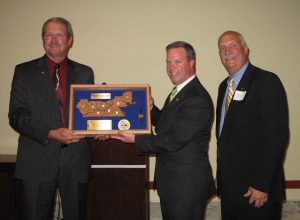
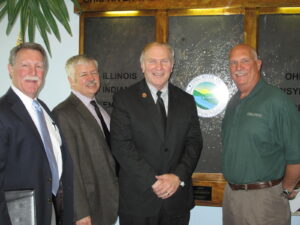
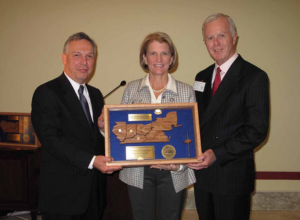
2009: Federal Commissioner Stu Bruny, U.S. Congressman Steve Driehaus (OH), and Commissioner Paul Tomes (OH); ORSANCO Congressional Caucus Liaison Jerry Schulte, ORSANCO Executive Director Peter Tennant, Congressman Steve Chabot (OH) and Commissoner Paul Tomes; Commissioner Ron Potesta (WV), U.S Congresswoman Shelley Moore Capito (WV), and Commissioner David Flannery (WV).